Track Skin Changes Over Time: Photos, Notes & Checklists
Skin Changes Made Clear: A Practical Guide to Tracking Skin Changes Over Time
Noticing a new spot, an itching patch, or a mole that looks “different” can feel unsettling—especially when you’re relying on memory to compare what you saw weeks ago. A simple, repeatable tracking system (photos, notes, and a consistent schedule) makes it easier to spot meaningful trends, share clear information with a clinician, and avoid guesswork.
If you’d like a guided format with prompts and checklists, Skin Changes Made Clear: A Practical Guide to Tracking Skin Changes Over Time is designed to help you stay consistent without overcomplicating the process.
What counts as a “skin change” worth tracking
Tracking works best when you know what you’re watching for. “Skin changes” aren’t limited to moles—any persistent or evolving change can be worth documenting.
- New growths or spots: moles, freckles, bumps, skin tags, cyst-like lumps, and scaly patches.
- Changes in an existing mark: size, shape, color, border, elevation, texture, itch/pain, bleeding, crusting, or oozing.
- Non-spot changes: persistent redness, darkening/lightening, swelling, dryness, cracking, or recurring rashes in the same location.
- Pattern changes: flares linked to shaving, friction, new products, sun exposure, exercise, stress, or seasonal shifts.
- Higher-priority situations: rapid changes over weeks, lesions that don’t heal, or anything that bleeds without clear injury.
For a clinician-backed approach to checking your skin, the American Academy of Dermatology Association’s self-exam guidance can help you understand what to look for and how to do a thorough check.
Set up a tracking routine that stays consistent
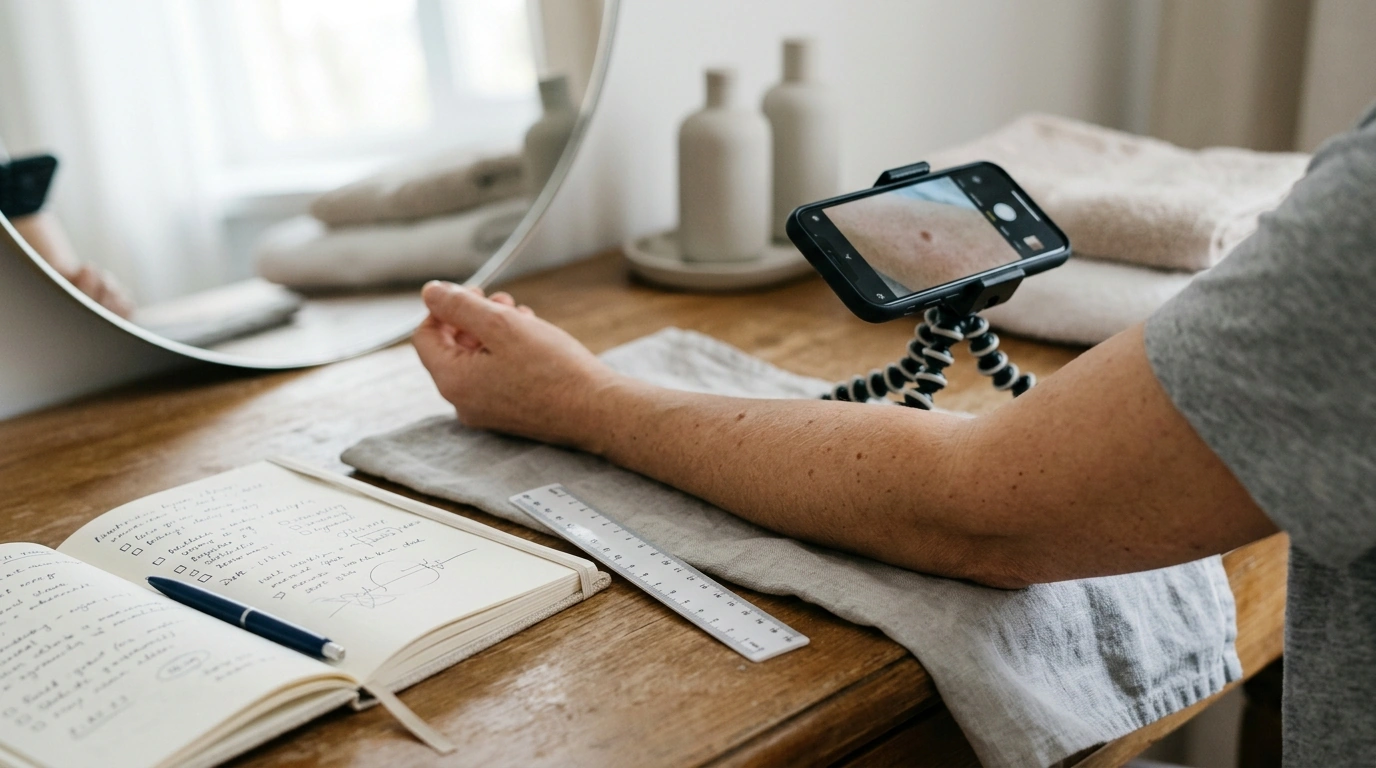
The goal isn’t perfect documentation—it’s repeatability. A “good enough” system you’ll actually follow is more useful than an elaborate setup you abandon after two weeks.
- Pick a schedule: monthly for general monitoring; weekly for a specific concern; sooner if a clinician advises.
- Standardize lighting and distance: same room and similar time of day when possible; no filters; wipe the camera lens.
- Use a reference for scale: a ruler, coin, or measuring tape next to (not on top of) the spot.
- Create a body map: note the exact location (example: “left forearm, 6 cm below elbow crease, inner side”).
- Keep product and sun notes: new skincare, hair removal, bandages, workouts, sunburns, tanning, or trips.
Sun exposure can change pigmentation and irritation patterns over time. For prevention basics and risk reduction habits, see the CDC’s skin cancer prevention information.
How to take clear comparison photos
Good photos reduce uncertainty. The best comparison images look boringly similar each time—same framing, same lighting, and the same “rules” for how the photo is taken.
- Take three angles per check-in: straight on, slightly angled, and wider context so the location is unmistakable.
- Hold the camera steady: use a timer, prop the phone, or ask for help for hard-to-see areas (back, scalp).
- Avoid misleading color: remove heavy makeup; don’t photograph immediately after hot showers or exercise if redness is the concern.
- Label files immediately: date + body location (example: “2026-08-04_right-shoulder_close.jpg”).
- Use a consistent order: if tracking multiple spots, photograph head-to-toe to reduce omissions.
A simple checklist for evaluating moles and spots
A structured review makes month-to-month comparisons faster and more objective. Don’t rely only on “it looks about the same”—measure and note symptoms.
Quick tracking checklist for one spot
| What to note | What it looks/feels like today | Since last check-in |
|---|---|---|
| Size (mm) and elevation | Measure with ruler; flat/raised | Bigger/smaller/no change |
| Shape and border | Round/oval/irregular; smooth/jagged | More irregular/sharper/blurrier |
| Color | Tan/brown/black/red/pink/multicolor | Darker/lighter/new colors |
| Surface | Smooth/scaly/crusted/ulcerated | New scale/crust/not healing |
| Symptoms | Itch/pain/tenderness/none | New or worsening |
| Bleeding or oozing | Yes/no; spontaneous or after rubbing | New/recurrent |
| Photo set captured | Close + angled + wider context | Complete/missing angle |
When to get medical advice sooner
Organize records so they’re useful at an appointment
A guided option for building a consistent system
If your photos and notes tend to end up scattered across your camera roll and reminders app, a structured guide can make the process repeatable. Skin Changes Made Clear: A Practical Guide to Tracking Skin Changes Over Time focuses on consistency (same lighting/angles), symptom logging, and clear “when to seek care” thresholds.
For people who stay motivated with checklists and habit-style routines, Soulful Success Checklist: Your Step-by-Step Guide to Spiritual Goals can also serve as a simple framework for building a steady weekly/monthly check-in habit alongside your health routines.
FAQ
How often should skin changes be photographed and logged?
For general monitoring, a monthly check-in is a practical cadence; for one specific concern, weekly photos and notes can make changes easier to spot. If something is changing rapidly or a clinician advises a different schedule, follow that guidance and seek earlier evaluation rather than waiting for the next planned date.
What’s the easiest way to measure a mole or spot at home?
Use a small ruler or measurement tape and take the photo with the scale placed next to the spot (not covering it). Record the measurement in millimeters and repeat the same method and angle each time for the most reliable comparisons.
What changes should trigger a dermatologist visit rather than continued monitoring?
Rapid growth, new irregular pigment, repeated bleeding/crusting, a sore that doesn’t heal, or new pain/itch paired with visible change are good reasons to get checked sooner. If you have higher risk factors (personal or strong family history, many atypical moles, significant sun exposure), don’t delay care just to gather more photos.
















Leave a comment