Comic Book Idea Checklist: Story Seeds to Drawing Prompts
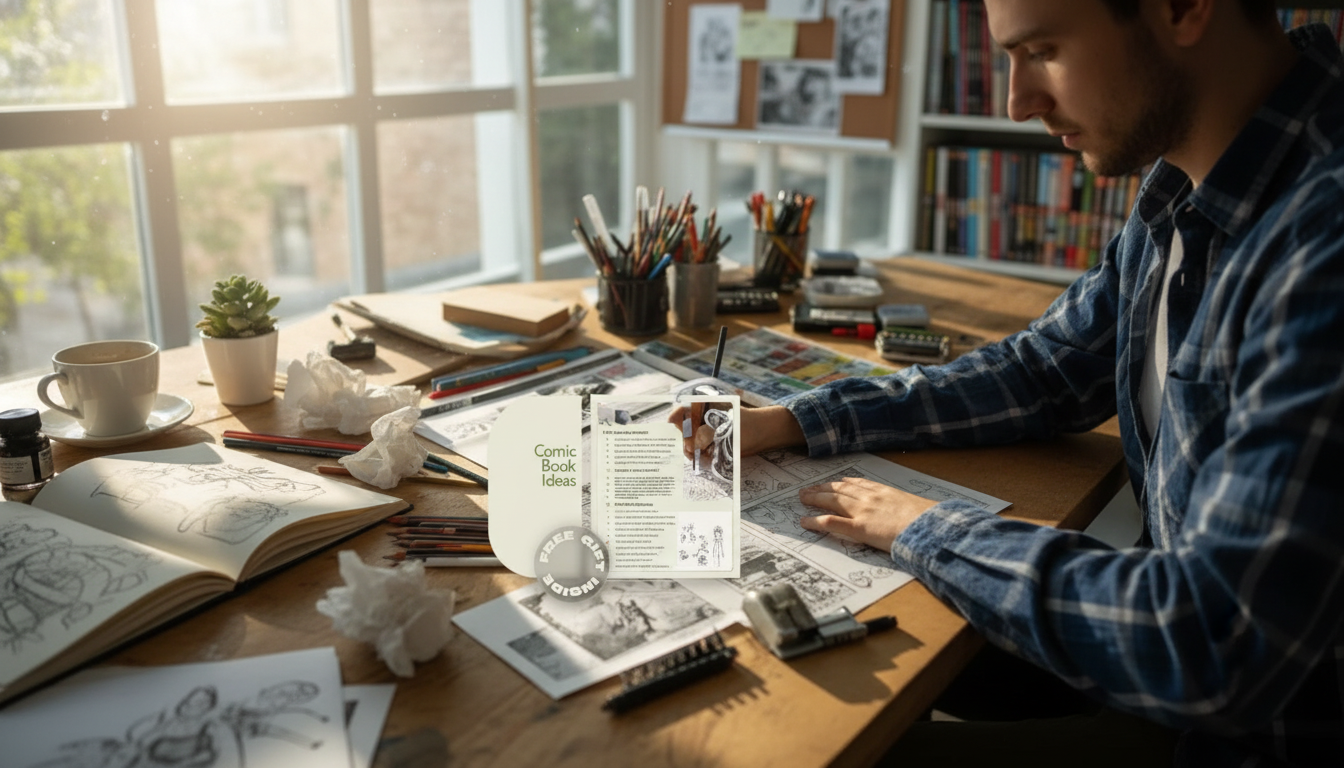
Draw Your Story: A Creative Checklist for Comic Book Ideas and Drawing Prompts
A strong comic starts with clear story choices: a main character with a want, a world with rules, and a problem that forces change. A creative checklist helps turn scattered inspiration into a repeatable process—so new panels, scenes, and pages come faster, with fewer blank-page stalls. For more guidance, see Teaching Comics – The Center for Cartoon Studies.
What “Draw Your Story” Helps Create
When you’re juggling story, pacing, and art at the same time, a simple structure can keep your comic moving. This checklist approach is designed to help you generate comic-ready seeds and translate them into scenes you can actually draw. For further reading, see 45 Essential Books for Comic Creators – Jason Thibault.
- A fast way to generate comic-ready story seeds (character + goal + obstacle + twist).
- Drawing prompts that translate story beats into visual moments (reveals, reactions, action, quiet beats).
- A structured path from idea to short script, thumbnail layouts, and finished pages.
- A flexible toolkit for one-shots, strips, zines, and longer series planning.
What’s Inside the Download
The core value of a checklist is that it narrows your next decision to something actionable. Instead of “make a comic,” you get targeted questions that produce scenes, panel beats, and visual priorities.
- Checklist prompts for characters: identity, motivation, flaw, relationships, visual signature, and contrast.
- World and setting prompts: time period, rules, social pressures, hazards, and everyday details that add authenticity.
- Plot drivers: inciting incident ideas, escalating complications, reversals, and endings that land emotionally.
- Scene and panel prompts: body language, composition shifts, props, visual metaphors, and silent storytelling beats.
- A quick “spark-to-page” flow to move from concept to thumbnails without overthinking.
From idea to page: a simple checklist workflow
| Stage | Goal | Checklist focus | Output to aim for |
|---|---|---|---|
| Spark | Choose a core situation | Who wants what, and what blocks it? | One-sentence premise |
| Shape | Add stakes and change | Pressure, consequence, and a turning point | 3–5 beat outline |
| Script-lite | Decide what happens per scene | Action, emotion, reveal, decision | 1–2 page scene list or rough script |
| Thumbnails | Solve storytelling visually | Panel rhythm, camera distance, page turns | Tiny page layouts |
| Pencils/Inks | Commit to clarity | Silhouettes, focal points, readable expressions | Final line art |
| Lettering/Polish | Make it readable and finished | Balloon placement, sound effects, contrast | Share-ready pages |
How to Use the Checklist in 15 Minutes
A short timer creates healthy urgency: you’re not trying to perfect a universe—just to reach the next drawable moment. Treat the checklist like a pre-flight check, not a rulebook.
- Pick a format first: 1-page gag, 4-panel strip, 8-page short, or a chapter opener—constraints boost creativity.
- Answer only the prompts that unlock momentum; skip anything that slows the next drawable moment.
- Turn answers into a “must-draw” list: 3 key actions, 2 emotional reactions, 1 reveal, 1 setting detail.
- Thumbnail before refining dialogue—visual clarity prevents later rewrites.
- Finish a small unit (a single page or scene) before expanding the concept into a longer arc.
Character Prompts That Create Instant Conflict
Characters become compelling when their wants collide with costs. If your hero can get what they want with no risk, the page goes flat—no matter how good the art is.
- Desire vs. fear: define one thing the character wants and the cost they dread paying.
- A flaw that affects action: impatience, pride, avoidance, or overcontrol—make it show in choices.
- A visual hook: silhouette, accessory, posture, or repeated motif that communicates personality in one panel.
- A relationship engine: ally, rival, mentor, or dependent who forces difficult decisions.
- A “mask and reveal” moment: what the character hides, and the scene that exposes it.
Setting Prompts That Give Pages Depth
Settings aren’t wallpaper. They add friction, offer tools, and signal tone—often without a single word balloon.
- Rules of the world: what’s normal here, and what’s forbidden?
- A daily-life detail: signs, routines, tools, clutter, weather—small visuals that sell the scene.
- A constraint that creates plot: curfew, limited oxygen, public surveillance, unreliable magic, strict etiquette.
- A location with built-in staging: narrow corridors, crowded markets, rooftop paths, elevators, bridges.
- A setting change that shifts tone: safe → unsafe, public → private, bright → dim, open → cramped.
Plot and Page-Turn Prompts for Short Comics
Short comics thrive on momentum. A clear turn—especially one you can show visually—gives the ending a satisfying snap.
Drawing Prompts That Improve Storytelling Clarity
Quick Formats to Try When Stuck
Who This Checklist Fits Best
Get the Download
- Draw Your Story: Comic Book Ideas | Creative Checklist for Artists & Storytellers | Comic Book Drawing Ideas Download
- Feel Alive Again Checklist – Digital Download Self-Care Guide
For deeper craft reading and historical context, two respected references are Understanding Comics: The Invisible Art by Scott McCloud and the Library of Congress comics research guides.
FAQ
Is this better for writing story ideas or for drawing prompts?
It supports both: story-building questions generate a clear premise and beats, then panel-focused cues turn those beats into drawable moments. The workflow helps move from a one-sentence situation to thumbnails without getting stuck in abstract planning.
Can it help if the goal is a short comic, not a full series?
Yes—short formats benefit the most from a tight checklist because you can aim for one strong change or reveal as the ending. Quick structures like four-panel strips and one-page mini-arcs make it easy to finish something complete and satisfying.
How should the checklist be used without overplanning?
Time-box it to 10–15 minutes, answer only the prompts that unlock the next scene, and move to thumbnails early. If a question doesn’t help you decide what to draw next, skip it and keep momentum.















Leave a comment