JetHexa ROS Hexapod: Jetson Nano SLAM & Navigation
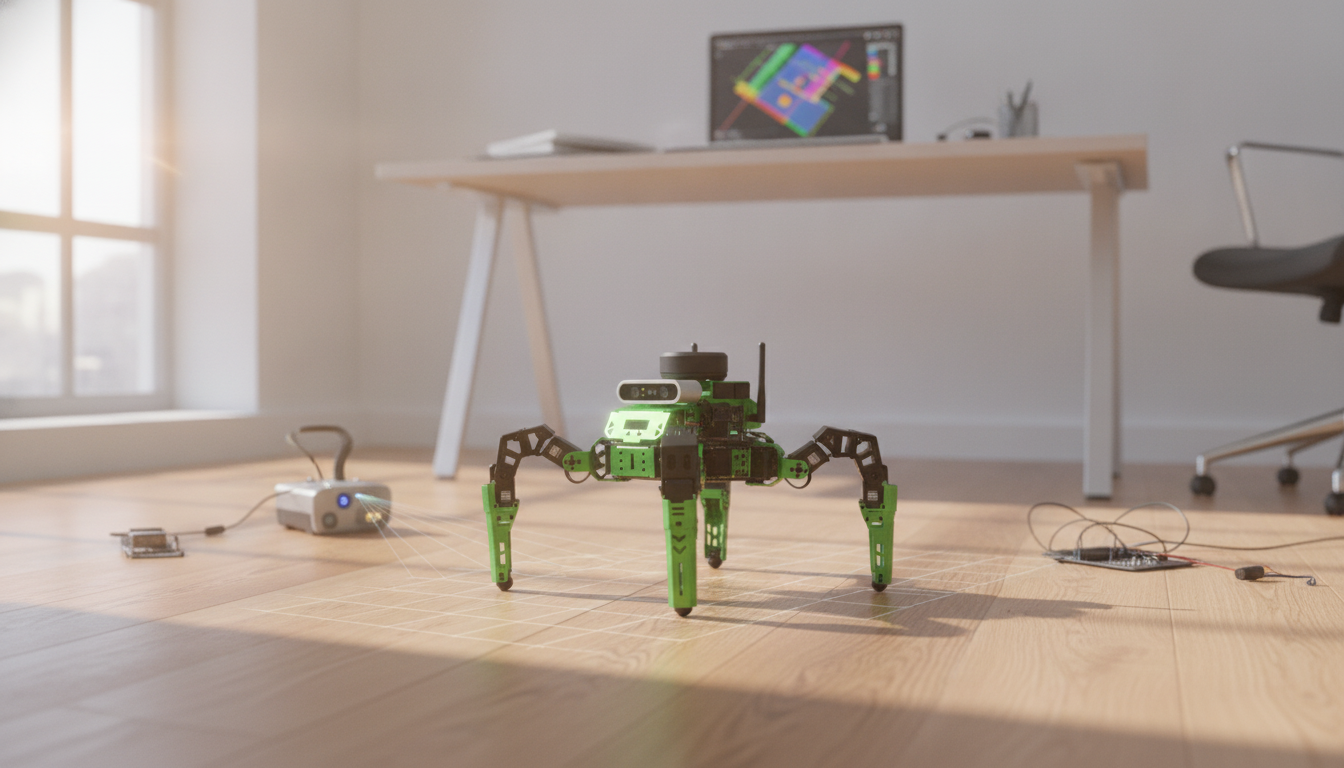
JetHexa ROS Hexapod Robot Kit with SLAM Mapping and Navigation (Jetson Nano Powered)
JetHexa is a six-legged ROS robot kit designed for hands-on autonomy work where stable mobility and real-time perception matter. Powered by NVIDIA Jetson Nano, it supports SLAM mapping and navigation workflows that fit indoor robotics learning, research prototyping, and lab-ready demos. The result is a practical platform for building maps of rooms and corridors, localizing on those maps, and navigating to goals with obstacle awareness—while experiencing the real-world quirks that never show up in simulation.
What JetHexa Is Built For
- Legged mobility for indoor environments where wheels struggle with thresholds, rugs, cables, or uneven flooring.
- ROS-based development for mapping, localization, and autonomous navigation experiments.
- Jetson Nano edge compute for perception pipelines and real-time sensor processing without a tethered desktop.
- A clear bridge between theory and a physical robot that can map, move, and repeat tests.
For teams building repeatable autonomy experiments, JetHexa is especially useful when you want a compact platform that can traverse typical indoor disruptions while keeping sensors steady enough to produce usable maps.
Core Capabilities: SLAM Mapping and Navigation
SLAM (Simultaneous Localization and Mapping) is the autonomy loop that lets a robot build a map while also estimating its own position. Once a map exists, navigation shifts to localization (tracking pose on the saved map) plus path planning (choosing a safe route) and control (moving along that route while reacting to obstacles).
- SLAM workflow: collect sensor data, build a map, localize within that map, then plan safe paths.
- Navigation workflow: define goals, generate global plans, avoid obstacles with local planners, and recover from blocked routes.
- Common ROS stack pieces: TF transforms, sensor topics, odometry, map server, and planning nodes.
- Best-fit environments: rooms, corridors, classrooms, lab spaces, and structured indoor courses.
Typical autonomy pipeline and what each stage produces
| Stage | What it does | Output you can visualize |
|---|---|---|
| Sensor ingestion | Collects range/vision/IMU data and timestamps it | Raw scans/images; IMU plots |
| SLAM | Builds a map while estimating robot pose | 2D occupancy grid and pose trace |
| Localization | Tracks pose on an existing map | Pose estimate with covariance |
| Planning + control | Plans a route and generates velocity/step commands | Planned path and obstacle costmaps |
If you’re building on ROS, the official Robot Operating System (ROS) documentation is the best reference for core concepts like nodes, topics, TF, and package workflows. For SLAM background and algorithm pointers, OpenSLAM resources provide a helpful map of the ecosystem.
Jetson Nano Compute: What It Enables
JetHexa’s Jetson Nano foundation makes it practical to run mapping, navigation, and perception on the robot itself. That reduces latency, simplifies demos, and helps keep experiments portable—especially in classrooms or labs where moving a tethered workstation is a hassle.
- On-device processing for SLAM, navigation, and perception without tethering to a desktop.
- More headroom for camera-based features, lightweight neural inference, and multi-sensor fusion experiments.
- Faster iteration: tune parameters live, record ROS bags, and replay logs directly on the robot.
- Clear scaling path: streamline node graphs, prune pipelines, and apply acceleration where available.
For Jetson platform details and capabilities, the NVIDIA Jetson Nano Developer Kit page is a solid baseline for compute expectations and supported tooling.
Why a Hexapod for Mapping and Autonomy
Hexapods bring a different set of strengths than wheeled bases—especially in indoor spaces that are “mostly flat” but filled with small annoyances that derail traction or clearance.
- Static stability: a hexapod can keep a stable stance while repositioning legs, which helps during cautious navigation and goal alignment.
- Terrain tolerance: thresholds, cords, and small obstacles that can stop wheels are often manageable with careful foot placement.
- Controlled motion: slower, deliberate gaits can reduce motion blur and improve consistency of sensor data for mapping.
- Research angles: gait tuning, basic foothold strategies, and navigation behavior under legged motion constraints.
Setup Path: From Unboxing to First Autonomous Run
A reliable autonomy demo comes from staged bring-up. Treat each layer—mechanical, sensors, motion, mapping, then navigation—as a checkpoint with clear “pass/fail” signs.
Project Ideas That Match the Platform
What to Check Before Buying
JetHexa Kit Listing and Purchase Details
JetHexa ROS Hexapod Robot Kit SLAM Mapping and Navigation Enabled, Jetson Nano Powered
Quick purchase snapshot
| Item | Details |
|---|---|
| Product | JetHexa ROS Hexapod Robot Kit SLAM Mapping and Navigation Enabled, Jetson Nano Powered |
| Price | 1456.49 USD |
| Stock status | In stock |
More in-stock items
- Your Smart Guide to Investing in Rural Real Estate | Digital eBook for Beginners & Investors | Rural Real Estate Investment Guide PDF Download
- Your Smart Start Checklist for Commercial Property Success – Commercial Property Investment Guide, eBook for New Investors, Digital Download
FAQ
What does SLAM mapping and navigation mean on a robot like JetHexa?
It means the robot can build a map of an area while estimating its own position, then use that saved map to localize and plan routes to goal points. Navigation adds obstacle avoidance and recovery behaviors so the robot can keep moving safely when the environment changes.
Is Jetson Nano enough for real-time mapping and navigation?
For typical indoor SLAM and navigation workloads, Jetson Nano can be sufficient when sensor rates and parameters are tuned appropriately. Performance depends on sensor choice and pipeline complexity, and many setups improve reliability by simplifying perception, reducing data rates, or optimizing node configurations.
What’s the recommended first test to confirm everything is working?
Start with power and servo checks, then do a short teleop drive to confirm stable gait and turning. Next verify sensor topics and the TF tree, run a small mapping loop and save the map, then load it and send a simple navigation goal in an uncluttered space.













Leave a comment