Build a 3D Wooden Puzzle Wall Clock with Quartz Precision
3D Wooden Puzzle DIY Wall Quartz Clock: A Buildable Timepiece That Looks Engineered
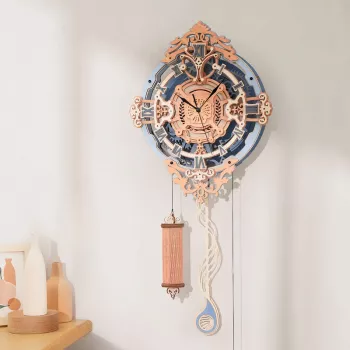
A wall clock can do more than tell time. The 3D Wooden Puzzle DIY Wall Quartz Clock Mechanical Design is made for people who want the satisfaction of building something with their hands—and the daily usefulness of hanging it up afterward. Once assembled, it reads like a mechanical display: layered wood, circular geometry, and gear-like detailing that gives the piece depth even when it’s perfectly still.
Instead of feeling mass-produced, the finished clock feels “made,” with visible structure and a workshop-inspired aesthetic. And because it runs on a quartz movement, it’s designed to be practical for everyday timekeeping, not just a shelf model.
What It Is and Why It’s Different
This kit is a DIY 3D wooden puzzle that assembles into a functional wall clock with a mechanical-inspired layout. The standout difference is the dual purpose: you get a hands-on model-building experience, then a finished piece that’s meant to live on your wall and be used daily.
The design leans into an engineered look—layered parts, structural frames, and motion-themed elements—without requiring metalworking tools or specialty fabrication. It’s a satisfying middle ground for anyone who likes the vibe of mechanical design but prefers the warmth and approachability of wood.
Who It’s Best For
- Hobby builders and model lovers who enjoy step-by-step assembly and a clean, precise final display.
- Teens and adults looking for a screen-free project that ends in something genuinely useful.
- Gift-givers who want to give an experience as much as an object—great for birthdays, holidays, and housewarmings.
- Home office, studio, and living-room decorators who gravitate toward technical, minimal, or handcrafted accents.
For a “project night” gift bundle, pairing the clock kit with a small add-on that supports a calm build session can make it feel intentional. A simple option is the Feel Alive Again Checklist – Digital Download Self-Care Guide, which works well as a gentle reset guide for a weekend build-and-unwind routine.
Build Experience: What Assembly Typically Feels Like
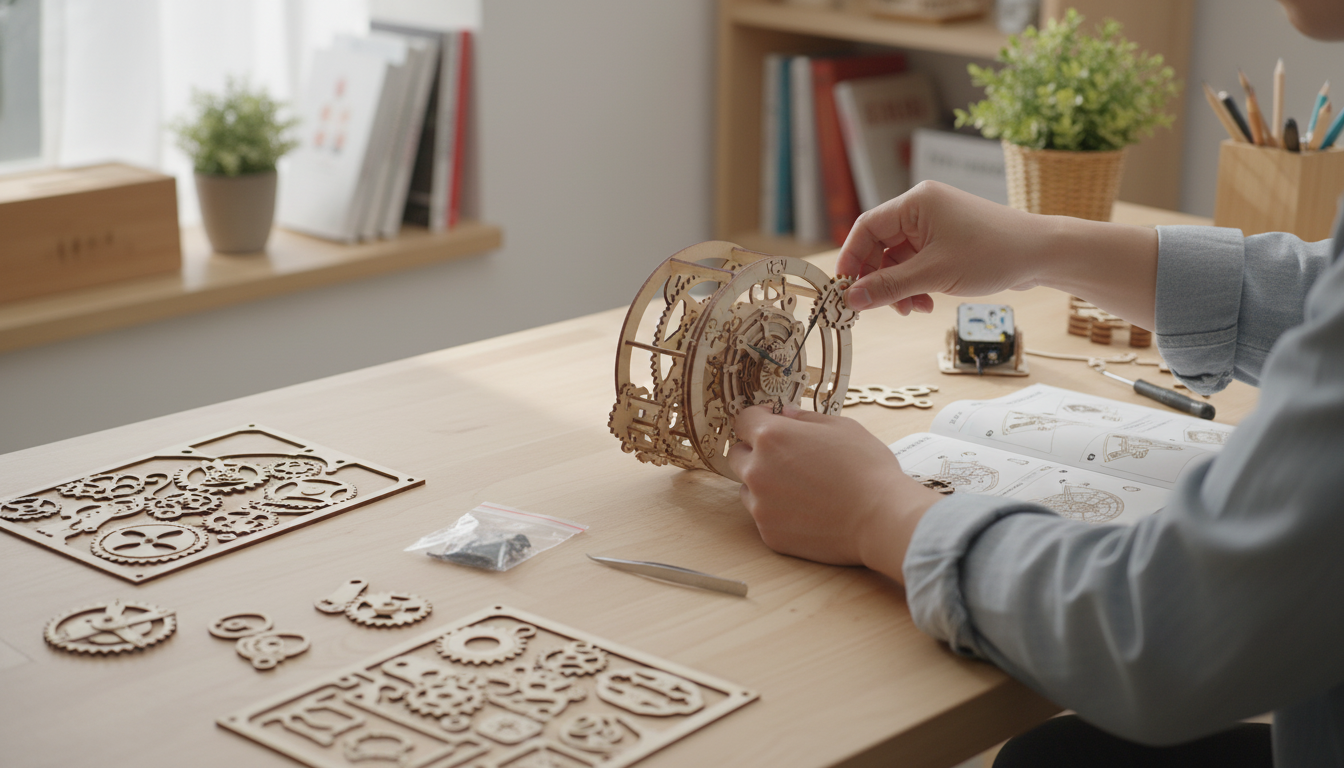
Assembly is paced and piece-by-piece, with lots of small “clicks” of progress as the layered structure comes together. This is the kind of build where careful alignment pays off—especially on visible edges and stacked layers where small shifts can affect the final symmetry.
- Dry-fit first when possible: test positioning before final placement to reduce stress on wooden tabs and avoid forcing joints.
- Set up the space: a clean, well-lit surface makes it easier to read part shapes and keep layers oriented correctly.
- Use a parts tray: sorting pieces before you start helps prevent the “where did that piece go?” slowdown.
- Find a rhythm: sort pieces, build sub-assemblies, then combine into the final wall-clock body.
It’s also a surprisingly good excuse to dress comfortably for a longer sit-down session—something like the New Balance Men’s Green Cotton T-shirt with Pocket fits the “workshop casual” vibe and gives you a handy pocket for a pencil or small notes while you build.
Mechanical Design Details to Appreciate
What makes this clock visually satisfying is how it uses layering to create depth and shadow. Instead of a flat face, you get an object with structure—something that looks assembled, engineered, and intentional.
- Layered wooden components: the stacked construction creates dimension that reads well from across a room.
- Circular forms and gear-like motifs: they add a sense of movement and mechanical “logic,” even when the clock is still.
- Quartz reliability with mechanical style: it’s designed to look mechanical but keep time with quartz consistency.
For context, quartz timekeeping is widely used because it’s stable and dependable, with the “heartbeat” of the clock regulated by crystal oscillation (a great overview is available via Britannica’s quartz clock reference). For deeper time-and-frequency background, the National Institute of Standards and Technology (NIST) Time and Frequency Division is an authoritative resource.
Quick Specs and At-a-Glance Comparison
If you’re deciding whether this kit fits the space, the recipient, or your preferred build style, the snapshot below helps clarify what it’s like to live with after it’s finished.
| Feature | What to Expect | Why It Matters |
|---|---|---|
| Project type | 3D wooden puzzle + functional wall clock | Delivers both an activity and a useful finished item |
| Timekeeping | Quartz clock movement | Reliable time display without mechanical clock tuning |
| Look and feel | Mechanical-inspired, layered wooden design | Adds depth and a crafted, engineered aesthetic to a wall |
| Skill approach | Careful alignment and patience rewarded | Cleaner fit and nicer final presentation |
| Best placements | Office, studio, hallway, living room | Decor impact where it’s visible and appreciated |
Setup and Hanging Tips After the Build
Care and Longevity
Gift Ideas and Pairings
- For makers: add tweezers, a sanding stick, mini clamps, and a parts tray for a more relaxed build session.
- For decor lovers: pair the finished clock with a warm desk lamp or a framed print to create a cohesive wall vignette.
- For stress relief and routines: combine the kit with the Feel Alive Again Checklist – Digital Download Self-Care Guide to turn the build into a planned weekend reset.
FAQ
Is the clock functional after assembly or just decorative?
It becomes a working wall clock after assembly, using a quartz movement for reliable everyday timekeeping. The mechanical-style structure also makes it a decorative display piece.
How long does the build usually take?
Most builders can expect a few hours, depending on pace and comfort with DIY kits. Taking breaks and focusing on alignment typically leads to a cleaner final result than rushing.
What should be prepared before starting the DIY build?
Set up a clear, well-lit workspace and use a small tray or organizer for parts. It also helps to plan for gentle dusting afterward to keep the layered details looking sharp.











Leave a comment