DIY Hand Crank Gramophone Explained: Gears, Stylus, Sound

How does a DIY hand crank gramophone model work, and what makes it play music?
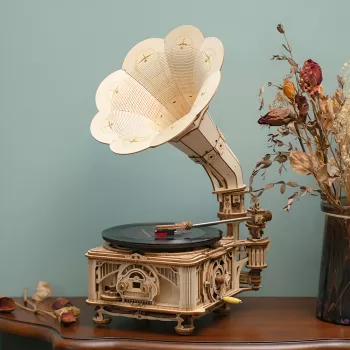
A DIY hand crank gramophone model works by turning simple mechanical motion into sound. When you rotate the crank, you’re supplying energy that spins a set of gears. Those gears regulate and transfer the motion to a rotating “record” or music disc. As the disc turns at a steady pace, a stylus (a tiny needle or tip) traces the grooves or bumps on the disc’s surface.
The grooves are the real “instructions” for the music. As the stylus rides through them, it vibrates back and forth. Those small vibrations travel into a diaphragm (a thin membrane inside the soundbox) and then into the horn or resonant body of the gramophone. The horn doesn’t create the music; it amplifies it by shaping and projecting the vibrations into the air so they become audible.
What makes it play music, specifically, is the combination of (1) consistent rotation from the crank-and-gear system, (2) groove-tracking by the stylus, and (3) amplification by the diaphragm and horn. If any of these pieces are misaligned—disc not spinning evenly, stylus not seated correctly, or soundbox not coupled tightly—you’ll still get motion, but the sound will be weak, scratchy, or distorted.
Many wooden hand-crank kits add another key ingredient: a governor or speed control mechanism. This helps keep the disc spinning at a more stable rate, which keeps pitch from wobbling. For a deeper, step-by-step look at the moving parts and how the kit is designed to play, see the full guide here: working wooden hand crank gramophone kit guide.
FAQ
What is the difference between a hand-crank gramophone and a modern record player?
A hand-crank gramophone is fully mechanical: you provide the power by turning a crank, and sound is amplified acoustically through a diaphragm and horn. A modern record player uses an electric motor for speed and electronics (cartridge, amplifier, speakers) to boost and shape the sound.














Leave a comment